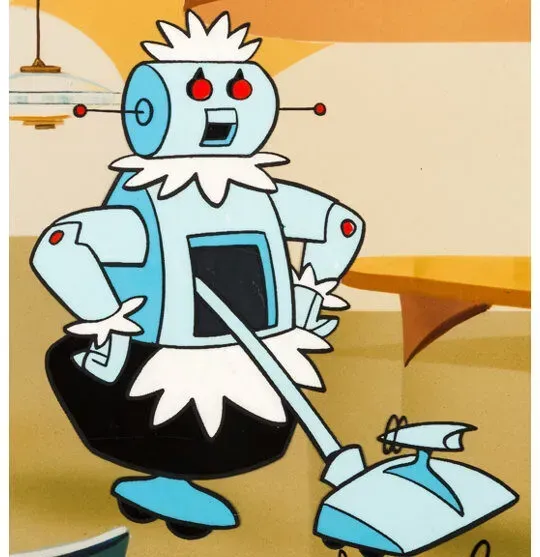
In 1962, The Jetsons introduced us to Rosie the Robot. She cleaned the house. She ran the schedule. She did exactly what she was told. And yet, half the time, she still got it wrong.
Rosie was not dumb. She was not malfunctioning. She was doing what machines have always done: executing instructions literally, without understanding intent. That is not a cartoon problem anymore. That is an AI problem.
The Mistake We Keep Making With AI
Large language models do not understand brands. They do not infer meaning. They do not read between the lines. They do not assume what you meant. They respond to the signals you give them. That is uncomfortable for a lot of brands, because most brand communication is built on implication:
- "People will get what we stand for."
- "The context is obvious."
- "Our reputation speaks for itself."
Humans fill in those gaps. Machines do not.
Rosie Did Not Understand Intent. She Understood Instructions.
Rosie followed instructions flawlessly, and still missed the point. That is exactly how AI behaves today. If your content is vague, abstract, or written only for human intuition, AI will still respond. Just not how you expect.
This is why brands can appear dominant in traditional search and still be invisible to AI recommendations. The system is not broken. It is doing exactly what it was instructed to do based on the inputs available.
Why SEO Is Not Enough Anymore
SEO was built for retrieval. GEO (Generative Engine Optimization) is built for interpretation. Search engines ask: "Which page matches this query?" Generative engines ask: "What do I say in response?"
That distinction matters. If your brand is not described clearly, consistently, and concretely across the web, AI has nothing reliable to say about you, so it fills the gap or skips you entirely. Not because it is biased against the brand, but because it lacks enough confidence to include it.
A Real-World Example: When SEO Works and AI Still Fails
Recently, I pulled into the parking lot of a Foxtail Coffee location. Open. Customers inside. Literally parked in front of the store. I asked an AI assistant a simple question: "Where can I grab a great cup of coffee?" It recommended a cafe more than a mile away. When I asked if there was anything closer, it told me there was nothing else in the area.
That was not true. Foxtail ranked first organically in traditional Google search for that location. From an SEO perspective, it was doing everything right. From a generative perspective, it might as well not have existed.
This was not an AI hallucination. It was an instruction gap. The system did not have enough clear, machine-readable context to confidently recommend the brand in a generative response. So it defaulted to safer alternatives. Just like Rosie, the model was not broken. It was acting on incomplete instructions.
Why This Keeps Happening
Generative systems do not retrieve pages. They construct answers. If your brand is obvious to humans, popular locally, and well-ranked in search, but poorly defined in ways machines can interpret, AI will hesitate. And when AI hesitates, it excludes. That is the quiet risk brands are walking into right now.
Do Not Blame Rosie for Cleaning the Wrong Room
This is the part that trips people up. When AI gives a bad answer, we blame the model. But most failures are not hallucinations. They are instruction failures:
- The signals were incomplete
- The language was ambiguous
- The intent was implied, not stated
Rosie did not clean the wrong room because she was broken. She cleaned the wrong room because the instructions were bad.
GEO Is Not About More Automation
It is about better instructions. Not more content. Not more keywords. Not outsourcing your voice to machines. It is about translating what humans mean into signals machines can reliably interpret. That is the shift we are in right now. The brands that win will not be the loudest or the most automated. They will be the clearest.
The Real Lesson From Rosie
AI does not need to be smarter. We need to be clearer. Because in an AI-mediated world, clarity is authority. And if Rosie cleans the wrong room, do not blame the robot. Fix the instructions. A free ARDI™ visibility check shows you the instruction gaps AI sees in your brand right now.
Related ARDI™ research: Real-World AI Failures.